Golden Retriever Weight Chart: Puppy to Adult by Month
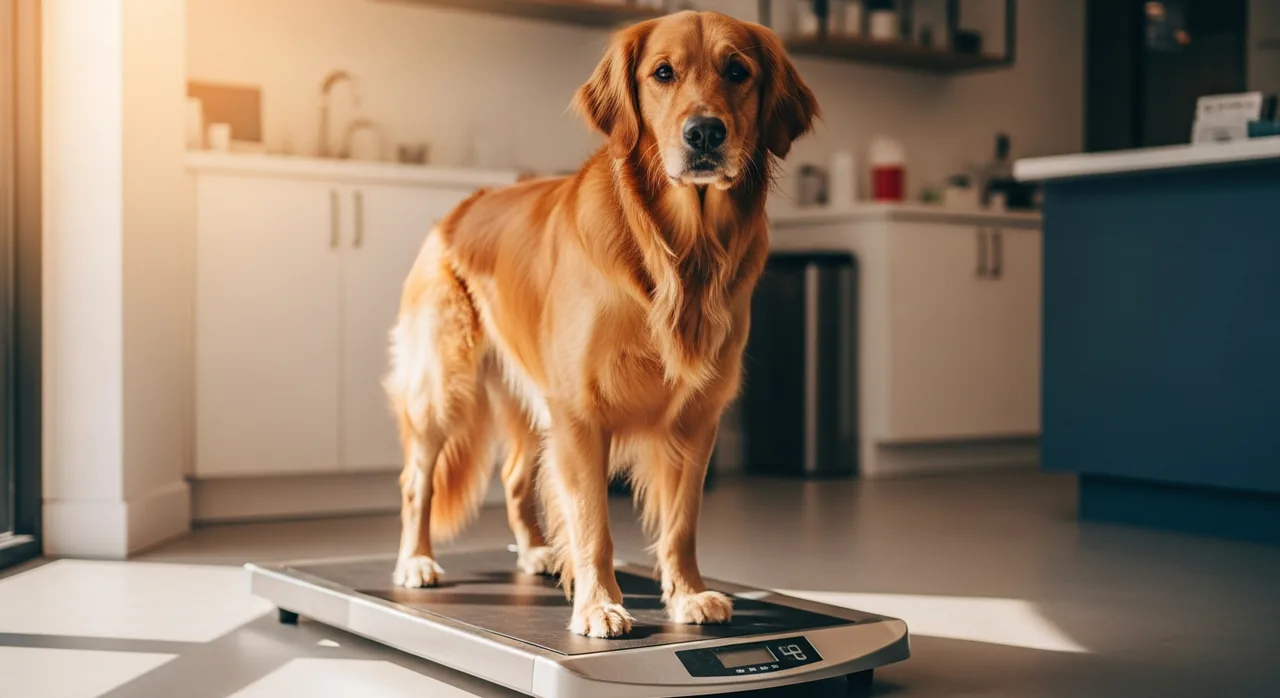
Somewhere around month four, nearly every golden retriever owner does the same thing: puts the puppy on a scale, opens a weight chart, and panics because the number doesn't match. Take a breath. Weight charts describe populations, not individual puppies, and healthy goldens routinely track above or below the printed ranges for months at a time. What matters is the shape of your puppy's growth curve — not any single number on any single day.
Below are month-by-month reference ranges for male and female goldens, followed by the part most charts skip: how to read the numbers so they inform you instead of alarming you.
Male Golden Retriever Weight Chart
Male goldens typically finish at 65–75 pounds. Ranges below reflect typical healthy variation; individual puppies from smaller field lines or larger show lines can fall outside them and still be perfectly on track for their own curve.
| Age | Typical weight (males) |
|---|---|
| 2 months | 10 – 15 lbs |
| 3 months | 20 – 25 lbs |
| 4 months | 28 – 35 lbs |
| 5 months | 35 – 45 lbs |
| 6 months | 40 – 52 lbs |
| 7 months | 45 – 58 lbs |
| 8 months | 50 – 62 lbs |
| 10 months | 55 – 67 lbs |
| 12 months | 60 – 72 lbs |
| Adult (18–24 months) | 65 – 75 lbs |
Female Golden Retriever Weight Chart
Females run roughly 10 pounds lighter at maturity, finishing at 55–65 pounds, and often plateau a little earlier than males.
| Age | Typical weight (females) |
|---|---|
| 2 months | 8 – 13 lbs |
| 3 months | 18 – 22 lbs |
| 4 months | 25 – 30 lbs |
| 5 months | 30 – 40 lbs |
| 6 months | 35 – 45 lbs |
| 7 months | 40 – 50 lbs |
| 8 months | 45 – 55 lbs |
| 10 months | 50 – 60 lbs |
| 12 months | 55 – 63 lbs |
| Adult (18–24 months) | 55 – 65 lbs |
Read Growth Curves, Not Points
Pediatricians don't worry about a child in the 20th percentile; they worry about a child who was in the 60th and dropped to the 20th. Apply the same logic to your puppy. A golden tracking steadily along the bottom of the ranges above is almost certainly a smaller-framed golden doing fine. The patterns worth attention are a curve that flattens abruptly, a sudden jump across the range, or weight loss during the growth phase. Weigh at the same time of day every week or two, write it down, and judge the trend line — not the Tuesday number.
Adult size is mostly set by genetics: the parents' weights predict your puppy's destination far better than any chart. For how weight fits into overall frame and height, see our golden retriever size guide.
Slowing Growth After 6 Months Is Normal
Goldens gain weight fastest between two and six months — often two pounds a week at the peak. Then the curve bends. From six months to a year, gains slow to a pound or less per week, and after twelve months most of the remaining change is muscle and chest filling out rather than height. Owners frequently misread this natural deceleration as a feeding problem and add food, which is exactly the wrong move: deliberately keeping large-breed puppies lean and slow-growing is associated with healthier joint development. Follow a structured plan like our puppy feeding schedule and let the curve bend. A full month-by-month picture of what develops when is in our guide to golden retriever growth stages.

Overweight Goldens: Use the Rib Test
Once your dog is grown, the scale becomes the less useful tool — a 70-pound golden can be fit or fat depending on frame. Veterinarians instead score body condition by look and feel, using standards like the WSAVA body condition score. The home version takes ten seconds:
- Ribs: run flat hands along the ribcage. You should feel each rib easily under light pressure, like the back of your hand — not have to press through padding.
- Waist: viewed from above, there should be a visible tuck behind the ribs. A golden shaped like a coffee table is carrying too much.
- Abdomen: from the side, the belly should slope upward from chest to hindquarters, not hang level.
Goldens are enthusiastic eaters and skilled beggars, and excess weight is one of the most common health problems vets see in the breed. Keeping a golden lean is also the best-evidenced way owners can extend lifespan — the difference measured in comparable breeds is on the order of two years.
Quick rule of thumb: a healthy golden at any age should have ribs you can feel but not see, a visible waist from above, and steady energy. If all three check out, an "off-chart" scale number is almost never a problem by itself.
When to Call the Vet
Charts and rib tests are screening tools, not diagnoses. Book a veterinary visit if you notice any of the following:
- Weight loss at any point during the growth phase, or unexplained loss in an adult
- A growth curve that flattens for three or more weeks before 8 months of age
- Poor appetite, lethargy, vomiting, or diarrhea accompanying a weight change
- A puppy dramatically below range who is also small-boned, pot-bellied, or dull-coated (possible parasites or malabsorption)
- Adult weight gain despite measured, appropriate portions — your vet may want to check thyroid function, since hypothyroidism is relatively common in goldens
Your veterinarian can weigh your dog on a calibrated scale, assign a proper body condition score, and rule out medical causes — all things a chart on the internet, including this one, cannot do.
The Bottom Line
Use the tables as guardrails, the trend line as your instrument, and the rib test as the final word. A golden that tracks its own steady curve, feels lean under your hands, and plays like a golden is on schedule — whatever the chart says.